Showing posts with label farming. Show all posts

Wednesday, January 25, 2012

(Almost) Wordless Wednesday

I spent the last week in Berlin, Germany, attending executive meetings of the International Federation of Agricultural Journalists. We were hosted by International Green Week, the world's largest food, agriculture and horticulture show.

The show features exhibitors from around the world, and many selling food and showcasing the agricultural specialties of their part of the world.

Here are a few sights... More to come in future blog posts...


This lovely German potato farmer seemed thrilled that I came to visit his booth in the agricultural section of International Green Week. He proudly told me that they had 420 varieties of potatoes on display.

Guess which country had the large tulip display? Holland, of course.

Pakistan's booth had a heavy emphasis on food traceability and food safety.

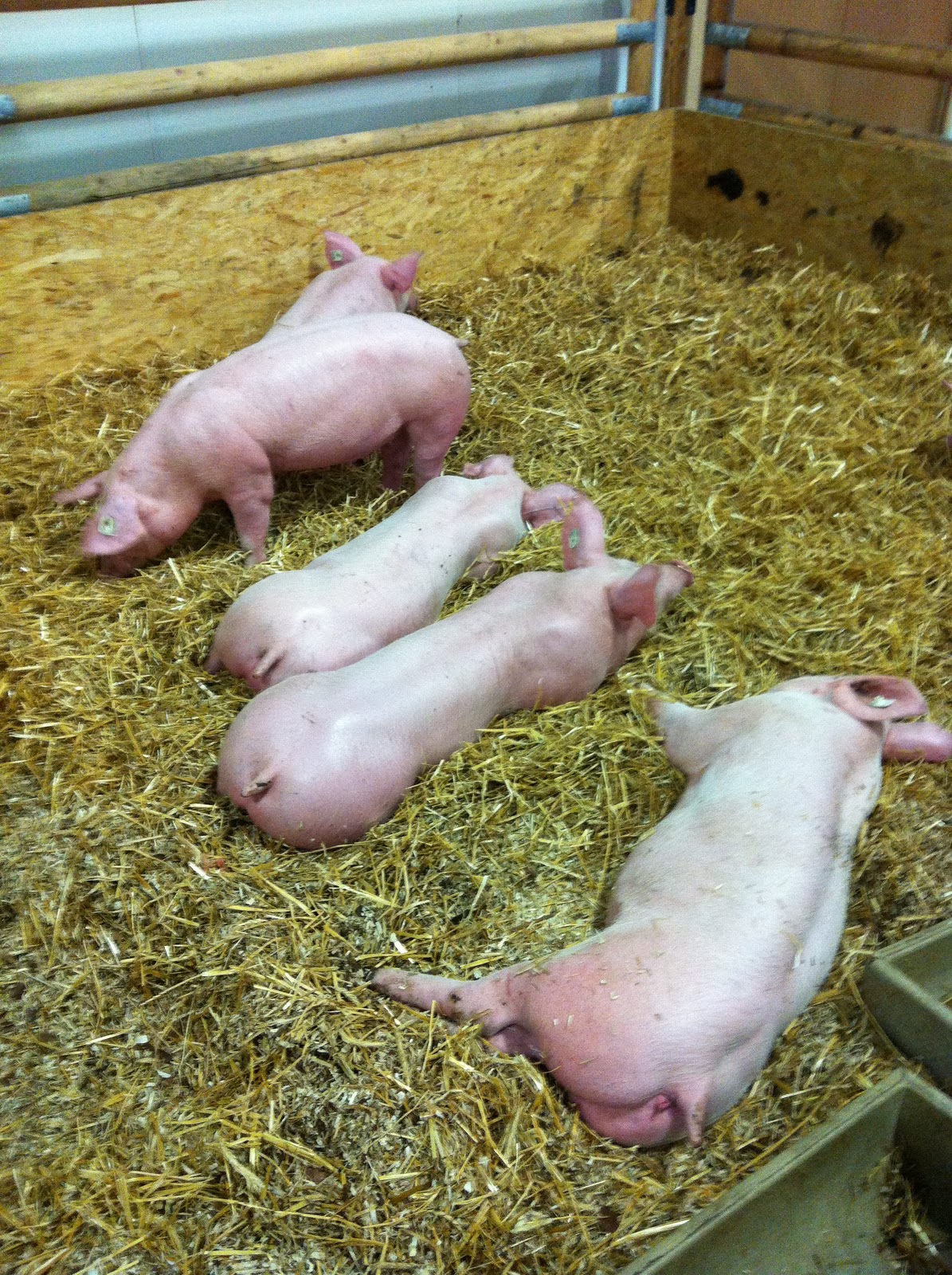
These guys didn't appear very impressed with International Green Week.

Saturday, February 12, 2011

Food Freedom Day

Today is Food Freedom Day in Canada.

That means the average Canadian has now earned enough disposable income to pay for his or her individual grocery bill -- food and alcohol only -- for the entire year.

And yes, it's only February 12.

This is the third year in a row that Food Freedom Day has fallen on this date, and only slightly later than in previous years. The recession and an increase in the price of food have helped push the date back. The calculation is made by comparing Canadians' disposable income and the amount we spend on food.

According to the Canadian Federation of Agriculture, in 2010 the average Canadian spent approximately 11.9 per cent of personal disposable income on food.

Beth Densmore, president of Nova Scotia Federation of Agriculture points out that even though we enjoy reasonably priced food in Nova Scotia and the rest of the country, Canadian farmers "continue to be challenged with gaining a fair return of the food dollar."
 
Consumers want cheap food that is reliably safe. Farmers want to get paid fairly for the food they produce. Should Canadians spend more than 11.9 per cent of disposable income on food? What's the value of a safe food supply? Is enough money getting back to farmers?
 
Food Freedom Day may be a good time to take pause to reflect on these types of questions.
 
More on Food Freedom Day.
 

Saturday, June 05, 2010

Brewing passion

It's hard to remember sometimes where our passion comes from. Do I truly love this here and now or do I love this because I always have?

I was feeling a bit of that when I set off for Belgium in April for the International Federation of Agriculture Journalists annual congress.

See, the idea of forming an Atlantic chapter of the Canadian Farm Writers' Federation was something that some of us in this part of Canada had been talking about for several years. Four of us had been talking prior to IFAJ and decided to get the ball rolling with an event at the end of April. But as for planning the details, we decided to wait until I returned from IFAJ in Belgium.

In the weeks leading to up to IFAJ in Belgium, I had worked on several additional contracts. In fact, after several consecutive 18 hour days, I calculated that I had written 10,000 words in seven days. By the time I reached Belgium, I was exhausted and feeling quite burnt out.

When I thought about continuing the push to form the Atlantic Canada Farm Writers Association, I was overwhelmed. So much work to, was it worth it? Is it a worthwhile project to put my time into? Why is it worthwhile? And whose big idea was this, anyways?!

But attending IFAJ just prior to the first meeting of the Atlantic Canada Farm Writers couldn't have been any more perfect. My passion was reignited.

I don't know exactly when it happened.

Maybe it was at the beginning or end of each day, when Janet and I caught up with what was going on in our respective lives. Or maybe it was hearing Billy's Facebook updates about his crazy travels to reach the congress, or when Rodney and I shared the joys of working from a home office, or when Markus blocked the bathroom door for me at the farm, or when many of us stared with disbelief at the Belgium blue cattle, or when Adrian told me about his recent trip to Africa, or one of the many times Joe cracked a joke, or when Marc let me try on his wooden shoes, or when Kelly, Lilian, Joanne and I piled into the clown car. Or, or, or, or....

All of the reasons, none of the reasons, each one individually, none of them in particular, all of them put together and so many more brought the passion back for me. It was never far away anyways, but you know, sometimes we just need reminding.

In Belgium, I was reminded of exactly why it was important to have a local farm writers' group: Farmers and agriculture -- around the world, throughout our country or in our own back yard -- have important stories to tell and we need to help them. It isn't any more complicated than that and it certainly isn't any simpler. And as writers who help tell these stories, we need to gather together so share our experiences about what works and what doesn’t work when we tell these stories. We need to learn about the new practices farmers are adopting and how they're working on the farm. We need to stay informed and up-to-date with the latest communication methods. We need to polish our photography skills and sharpen our reporting proficiency. We need to network with each other.

So zeal renewed, I came home and caught up with Wayne, Andy and Heather to plan our June 4 Atlantic Canada Farm Writers' Association meeting.

I have always been confident that we had the potential in Atlantic Canada to have a good size group, but how many would I actually see on June 4? Nine had contacted us and expressed an interest, so with that number in mind, I set off for Charlottetown. By the time I started my presentation talking about what CFWF and IFAJ have to offer to those of us in Atlantic Canada, there were 12 of us. Twelve!

I. Knew. We. Could. Do. It.

And do you know what the best part of whole experience was? I didn't have to "sell" them on the advantages of regional, national and international farm writers' groups. They already knew. They could feel the energy in the room and see the potential of what broader groups can offer. We're already brewing our very own passion, right here in Atlantic Canada.

Thursday, June 03, 2010

Allison's Follow Friday Twitter List

Here's my Follow Friday list for this week... and some of the reasons why these are great folks to follow.

@KimEagles - for her organizing tips
@upmagazine - for seeking out freelance writers
@AaronBillard - for the love of Star Wars
@LtoG - for her hard work at freelance writing
@briancormier - for his brilliant idea of buying two coffees at once at Tim's
@rebeccahannam - for her curiosity about all things ag
@SteakPerfection - come on... steak. Perfection. What more do I need to say?
@JPlovesCotton - for our shared love of making an entrance
@FredMarcoux - for hot news tips
@Tamara_Stecyk - for helping feed Edmonton's hungry

Friday, April 30, 2010

How two families tackle business decisions

originally printed in AgriSuccess, January, 2010. If you're interested in reprinting this, please contact me at allison@finnamore.ca

How do you make important decisions on your farm? Is there a lack of consultation or, on the other hand, is there so much talking it causes paralysis by analysis?

In the run of a day, there are dozens of decisions to make. From simple, straightforward choices to those that require planning and reflection, nearly every step during the day needs some background preparation before moving ahead.

Now, mix in a team of knowledgeable co-workers who also happen to be related to you – suddenly, even the simple decisions could become much more complicated. Many family farms in Canada seem to have found their stride working together, including Four E Farms in Leamington, Ont., and Steppler Farms near Miami, Man.

At Four E Farms, father Peter Epp and sons Ken, Ron and Ed produce 2,200 acres of corn, beans and wheat, and 240 acres of processing tomatoes. During their years in business together, family members each found a niche in the farm operation. In some instances, their roles evolved over time, while in other cases, the sons were guided by their father.

“Dad recognized some of our strengths and tried to guide some of us to certain areas, Ken recalls. “’Why don’t you do this?’ he would ask. If it worked out and we enjoyed it, then we stayed.”

And if it didn’t, the role changed. Finding each person’s place at Four E Farms took about 10 years, Ken says. Now, day-to-day operational decisions fall to the shareholder who handles that part of the farm.

At Steppler Farms, parents Dan and Pat are in partnership with their sons Ian, Geoff, Adam and Andre. The charolais, grain and honey producers formalized their partnership in 2008. Prior to that, each son was farming on his own, with everyone helping the other out. But they faced an annual mountain of accounting paperwork. When Dan and Pat started succession planning a few years ago, incorporation became part of their plan. The family has now pooled its resources and divided the workload, so decision-making is clear-cut and well-defined.

Since the sons farmed prior to incorporation, they knew their areas of specialty. Dan is chairperson and takes on the role of mediator and advisor. Dividing up the managerial roles between his sons provides each with autonomy.

“As operational bosses, each son makes and enacts day-to-day decisions and has the authority to make essential minor purchases like repairs, medications and so on,” Pat explains. Major expenditures and budget decisions are made by all five, with input from everyone.

Both the Epps and the Stepplers agree that decisionmaking in a family farm business relies on one very important factor: communication.

At Four E Farms, the Epp brothers and their father meet every morning to discuss farm plans for the day ahead.

“Sometimes, not everyone agrees, but you build a consensus,” Ken explains, noting that no matter what decisions the family farm faces, the family maintains a common philosophy. “We work for the good of the company and not the individual.”

The Stepplers, while firm believers in communication, were skeptical when it came to the idea of setting up formal meetings with those who are so close.

“At first the idea of family meetings seemed awkward,” Pat says. “Before incorporation, we talked or planned somewhat individually with no formal structure. Now, we conduct each meeting in a semi-formal manner.”

Dan and Pat set the agenda, including issues brought forward by the sons and matters they want discussed. With each decision, everyone has the opportunity for input.

“Dan actually goes around the table to make sure that each person states his opinion,” Pat explains. Meetings are monthly during the winter, but that changes with
the seasons.

“We hold weekly meetings to plan the work that is ahead of us for that week, as well as long-range decisions on things that have to be fixed or purchased,” Pat says. “Each morning, the four boys meet for about 20 minutes to plan out that day’s work so that when the workers arrive at 8 a.m., the day’s schedule is in place. Over the noon meal, any changes to this schedule are then made.”

Both families also agree that keeping an open mind when working with family helps facilitate decision-making.

“Choose your attitude,” Pat advises. “Recognize when to shrug your shoulders, when to press a point,” she says, adding this advice also applies to older generations, reluctant to release control.

Thursday, April 12, 2007

Snow?!


There's a snow storm on the horizon for my part of the province tomorrow. Forecasts say there is 20 centimetres on the way! Today, temperatures are slated to reach 11 C.

How crazy is this weather?

Easter morning was thrown into an upheaval when we had about 25 centimetres fall in the area -- I think it was the largest snowfall we've had all at once all winter.

I had hoped to take photos of the kids in their spring-like Easter clothes -- crisp, leafy greens and sharp, sparkling white. Instead, they're in their snowsuits, sitting on a snowbank. Hard to believe the grass was greening up just the day before.

Weather forecasting is a fine art and the meterologist who do this work have a tough time. But technology is improving. At the same time, meterologists are letting the general public know that their work is not an exact science. There are many variable with weather forecasting and what falls, or doesn't fall, from the sky is something that none of us can control. The scientists can only make their best educated guess.

Environment Canada has teamed with weather forecasters in the United States and Mexico to develop a broader spectrum of weather outcomes. It's called ensemble forecasting and uses weather prediction computer programs to develop 16 possible weather outcomes in Canada for conditions like cloud cover, surface wind speed, precipitation and surface air temperature.

But why?

Is this information really useful or does it just create an environment of information overload?

Well, for farmers, the more useful information like this, the better.

Ted O'Brien is acting manager of the National Service Office, Agriculture Meteorological Service of Canada with Environment Canada. He says a wider window of possible weather outcomes gives producers more information to determine weather predictions for their own farms.

Let's face it, there are no cut and dry answers when it comes to predicting the weather. With ensemble forecasting, we can see a range of possible weather conditions.

If the weather forecast indicates a high probability of rain, for example, producers have more information to base their field work priorities like planting, spraying or harvesting. The ensemble forecast system also provides other other information such as cloud cover and the liklihood of obtaining a range of surface temperatures.

“Producers are dealing with risks and probabilities all the time,” O’Brien says. “They’re factoring in what the forecast is saying, what they’re use to seeing and the condition of the crop – how wet it is – and trying to decide when to harvest, when to cut, when to seed. Providing a little more information so they can factor in better how weather is going to impact their operation is what we’re doing.”

For ensemble forecasting that can be tailored to your community, click here. But don’t let the complex-looking graphs scare you! A detailed explanation on how to read the graphs is located here. Other results of ensemble forecasting can be found here. Click on the “information” link at each page for instructions on how to read the maps.

Stay dry!